News
News posts from the AIHubMix team.
 Genie 4, explained: what world models are, and why Google keeps chasing them
On October 27, 2026, Google DeepMind announced Genie 4, its newest world model. Unlike an AI video model — which hands you a finished clip — Genie 4 generates a world you step into: it responds to your keyboard every frame, you can rewrite the scene mid-simulation with plain English, and the world now carries its own live sound — wind, footsteps, music, spoken dialogue — instead of a soundtrack laid over video afterwards. The new capabilities are the story, but they are also this moment's clea
 GPT-6.1 Terra vs GPT-5.6 Terra: Half the Price, What Changed, and Who Should Switch
OpenAI released GPT-6.1 Terra on 26 October 2026. It sits below Sol and Astra in the GPT-6 family, and it costs less than its predecessor, GPT-5.6 Terra: $1 per million input tokens instead of $2, and $5 per million output tokens instead of $12. The launch post pitches it for visual reasoning, computer use and writing. OpenAI's benchmarks show it reading screens and images better, and both OpenAI's and independent tests show far fewer factual errors. The short answer for GPT-5.6 Terra users:
 Kimi K3.1 Pro vs K3: What Changed, What It Costs, and Who Should Switch
Kimi K3.1 Pro is the first update to Kimi K3, the 2.8-trillion-parameter open-weight model Moonshot AI shipped on 16 July 2026. It launched on 23–24 October 2026 in the Kimi app, Kimi Code and the Kimi API. Moonshot's launch post calls it "the first model in our new K3.1 series and our most capable 3T-class open-weight model to date": a post-trained version of K3, trained with much more post-training compute across "hundreds of downstream domains". Moonshot claims gains in coding, 3D creation, a
 MiniMax M3.1 Flash Is Space Bunny: What Changed from M2.7 and M3, and What It Costs
In late September, a model with no maker's name on it topped OpenRouter's daily chart, ahead of DeepSeek V4.1 Flash, and stayed OpenCode's most-used model for five days straight. It was listed as Space Bunny Alpha, and it was free. That model was MiniMax M3.1 Flash. As of 19 October 2026 you can call it per token on AIHubMix as minimax-m3.1-flash, at $0.165 per million input tokens and $0.66 per million output tokens. The short version: * It replaces M2.7. Starting 19 October, MiniMax sends
 DeepSeek V4.1 Flash 1017: Same Price, Shorter Outputs, and AIHubMix vs OpenRouter Pricing
On Saturday, October 17, 2026, DeepSeek swapped the model behind its deepseek-flash API name for a new checkpoint, DeepSeek-V4.1-Flash-1017. The price did not move, the context window did not move, and the calling method did not move. What changed is the model: DeepSeek reports double-digit gains on terminal and program-building benchmarks, and says the new checkpoint finishes tasks faster with shorter outputs. The short answer: if you run coding agents or tool-heavy workflows on the September
 Free Qwen3.8 Max and Flash API on AIHubMix: Limits, End Date, and Your First Call
Update (October 27, 2026): The free campaign has ended. GMI Cloud's campaign credits ran out before the planned end around November 13, and qwen3.8-max-free and qwen3.8-flash-free now return 404 model_retired. To keep using Qwen3.8, drop -free from the model ID and call the paid qwen3.8-max or qwen3.8-flash. Alibaba's flagship Qwen3.8 Max and its fast sibling Qwen3.8 Flash are free to call on AIHubMix right now. The free model IDs are qwen3.8-max-free and qwen3.8-flash-free, and both cost $0 p
 Gemini 4 Argon: Frontier Scores, a 1M-Token Output Limit, and How to Call It Now
Gemini 4 Argon is Google's first Gemini 4 model and its strongest so far. Independent testers put it level with GPT-6 Astra, it tops the Vals Index for finance, legal and tax work, and it can write up to 1M tokens in a single answer. It also costs less per token than Astra, even after its introductory price ends. Argon became generally available on October 13, 2026. Google's announcement opened it to developers and enterprises through the paid Gemini API, Google AI Studio and Vertex AI, and to
 What Is Mistral Large 4? A Trillion-Parameter Specialist from Europe
Mistral Large 4 is Mistral AI's new flagship. It has about one trillion parameters, it is trained from scratch in Europe, and its open weights are due at the end of October 2026. It isn't the smartest model available. What makes it notable is that it leads in a few areas where closed flagships either refuse or fall behind: defensive security work, locating objects in images, and legal research agents. Mistral released it on October 6, 2026 as a public preview. Its nickname is "Le Chonk". This
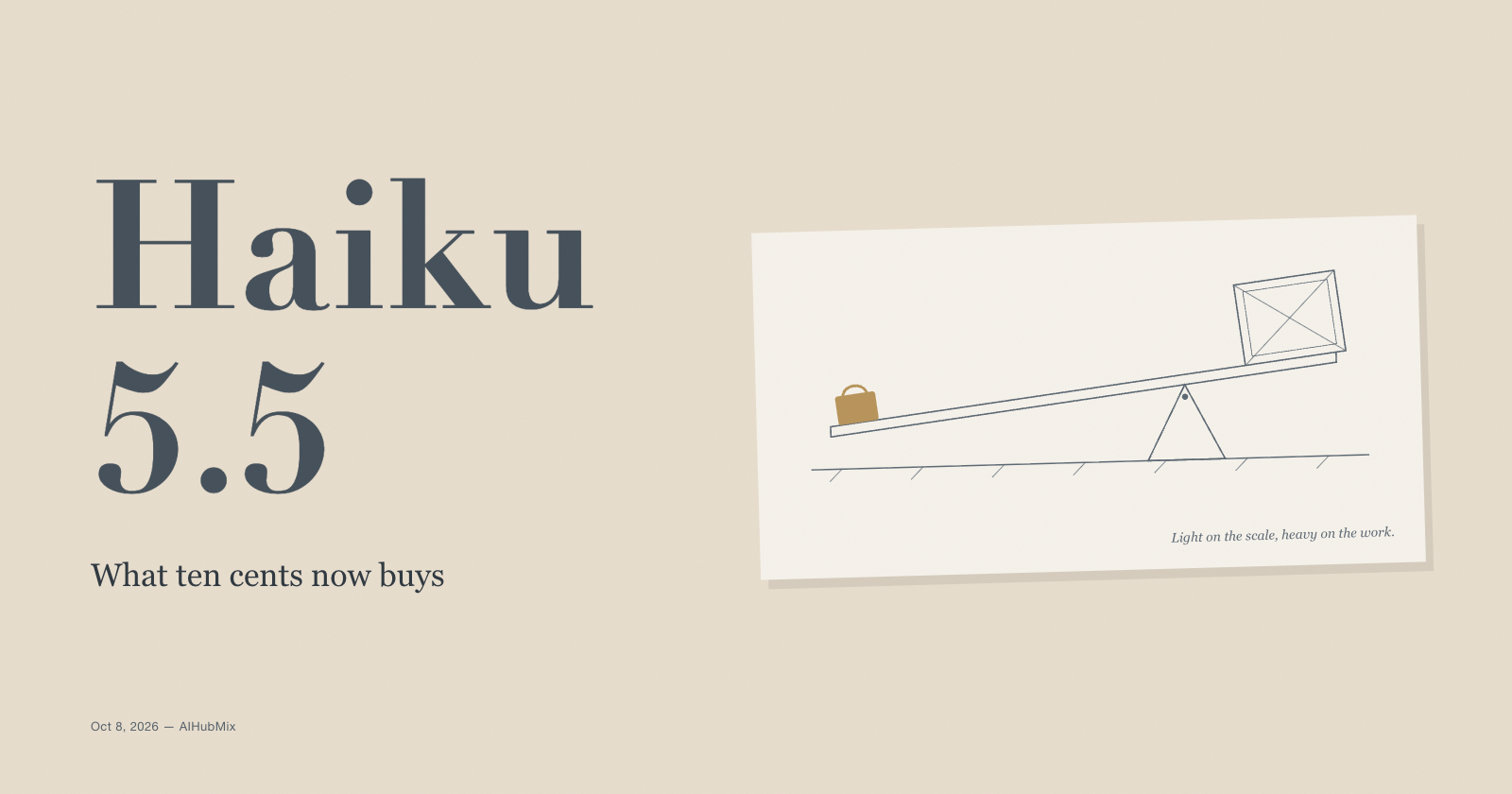 Claude Haiku 5.5 vs Haiku 4.5: What Ten Cents Now Buys
Claude Haiku 4.5 scored 0.0% on Terminal-Bench 4.0. Claude Haiku 5.5 scores 39.2%, and it costs a tenth as much per token: $0.10 per million input tokens and $0.50 per million output tokens, against $1 and $5 for Haiku 4.5. That is the upgrade in one line. The small Claude model went from "fine for classification, not for agents" to a usable subagent, and its price now matches OpenAI's GPT-6 Luna to the cent. Anthropic released it on October 7, 2026 as Claude Haiku 5.5, model ID claude-haiku-5
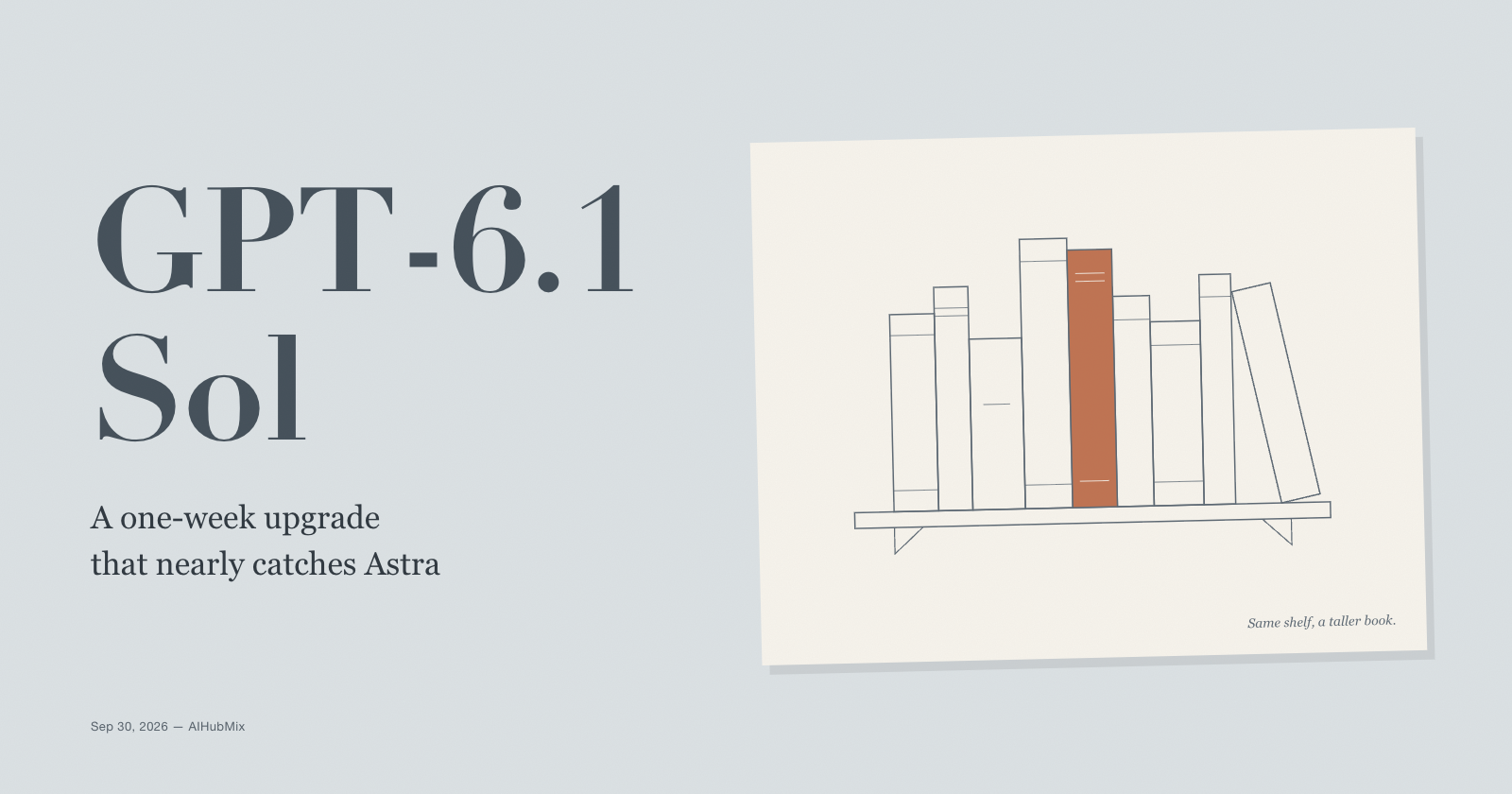 GPT-6.1 Sol vs GPT-6 Sol: A One-Week Upgrade That Nearly Catches Astra
OpenAI shipped GPT-6.1 Sol at DevDay on September 29, 2026. The timing is striking: GPT-6 Sol had been out for exactly one week (it launched September 22 alongside Luna), and the flagship GPT-6 Astra was less than a month old. The official model page sums up the pitch in one line: "Near-Astra performance for complex work at a lower cost." Concretely, that means agentic coding, computer use, and professional tasks at roughly Astra quality, for one fifth of Astra's per-token price. This post ans